© ericdentinger.com
2008-2026


Eric Maclewis - BAGPIPE SOUNDS
Eric Maclewis


Going Home
William Arms Fisher (1922)
Going home, going home
I'm just going home
Quiet-like, slip away
I'll be going home
It's not far, just close by
Jesus is the door
Work all done, laid aside
Fear and grief no more
Friends are there, waiting now
He is waiting too
See His smile, see His hand
He will lead me through
Morning star lights the way
Restless dream all done
Shadows gone, break of day
Life has just begun
Every tear wiped away
Pain and sickness gone
Wide awake there with Him
Peace goes on and on
Going home, going home
I'll be going home
See the Light, see the sun
I'm just going home
Classical music has often been inspired by the traditional or popular repertoire: for this piece, it is the opposite that has occurred since it is an adaptation for Scottish bagpipes of the main theme of the second movement (Largo) of the magnificent New World Symphony composed in 1893 by Antonín Dvořák (1841-1904).
This is not the only example of this type in the Scottish bagpipe repertoire: you can also discover The Green Hills Of Tyrol on this site, in an adaptation of Rossini's operas.
It should be noted that Dvořák, then director of the New York Conservatory, recognises an influence of the particularities of the music of the American Indians on the creation of his original themes.
This theme received lyrics from a student of Dvořák, William Arms Fisher, lyrics that gave its title to the bagpipe tune ("Going Home").
It can be interpreted on the occasion of funerals but its positive and light-filled purpose - due in part to the major mode - brings it very close to the famous Amazing Grace, authorising in my opinion the use in other circumstances...
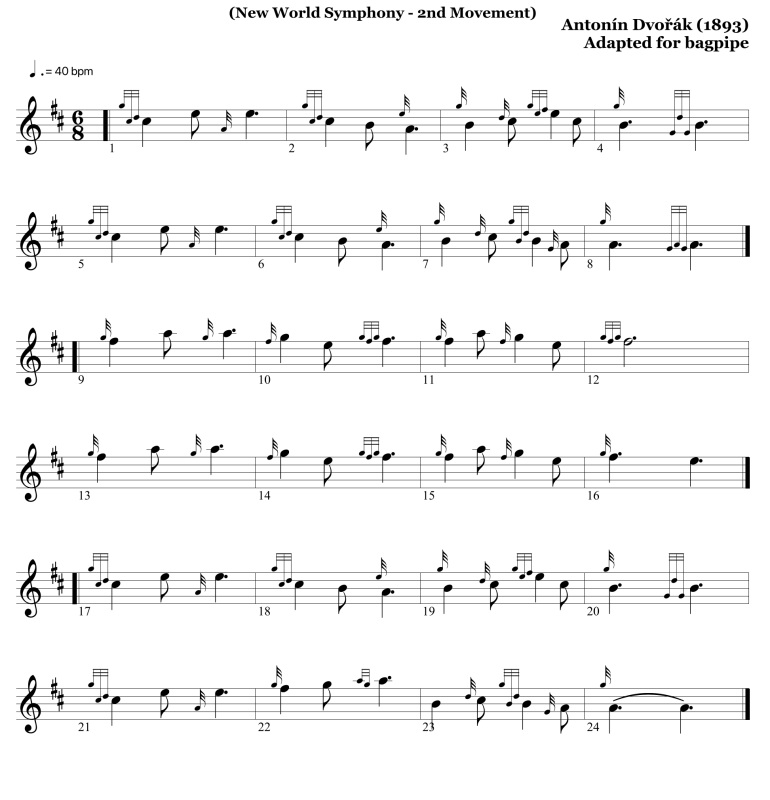
In view of the tone and limited sound range of the bagpipes, the transposition I propose includes some somewhat drastic adjustments, especially on the last four bars, without however altering the strength of the initial theme.
You can also find on the internet some differences in notation or structure, always for the bagpipe.
However, here is a superb melody that once again testifies to the opening of the repertoires.
Finally, it should be noted that Neil Armstrong listened to this symphony during the Apollo 11 mission that was to lead a first man to the Moon in 1969.
A new world...
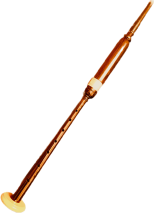
PRACTICE CHANTER:
The tempo is slow, so you may have some trouble following the metronome: try to do it nevertheless, this will frame your subsequent interpretation.
Take the time to soak up the original air to grasp the melody well even if the bagpipe offers a few different notes…
- the phrases are played only once,
- pay attention to the duration of the F bar 12: give it all its value, do not rush anything!
- add fermata at the end of some phrases if you wish.
- there are many doublings: raise your fingers well, separate your notes well, favour the clarity of the embellishment,
- work them as needed in isolation, same thing for the few grips present and also the birl bar 8.
Rhythmic placement :
- the first note of each doubling will be played on the beat = the index of the G grace note must touch the chanter right on the beat (“when your foot hits the floor”),
- same thing for the first note (Low G) of the birl bar 8.
- the grips (bars 4 and 20) are to be placed a little ahead of the beat.

GOING HOME
(New World Symphony)
SLOW AIR
- score by Eric Maclewis with CelticPipes